The Twenty-Eight-Year Short: Right Early Is Indistinguishable from Wrong
In Warren Buffett’s office hangs a piece of paper worth less than the nail holding it up: a Western Union stock certificate. Dangling between an award signed by Obama and a diploma from the famed Dale Carnegie public-speaking class. Looking back, Buffett can laugh and say “That’s when Charlie and I quit short selling.” Charlie would sigh and explain it was his third and final time betting against stocks.
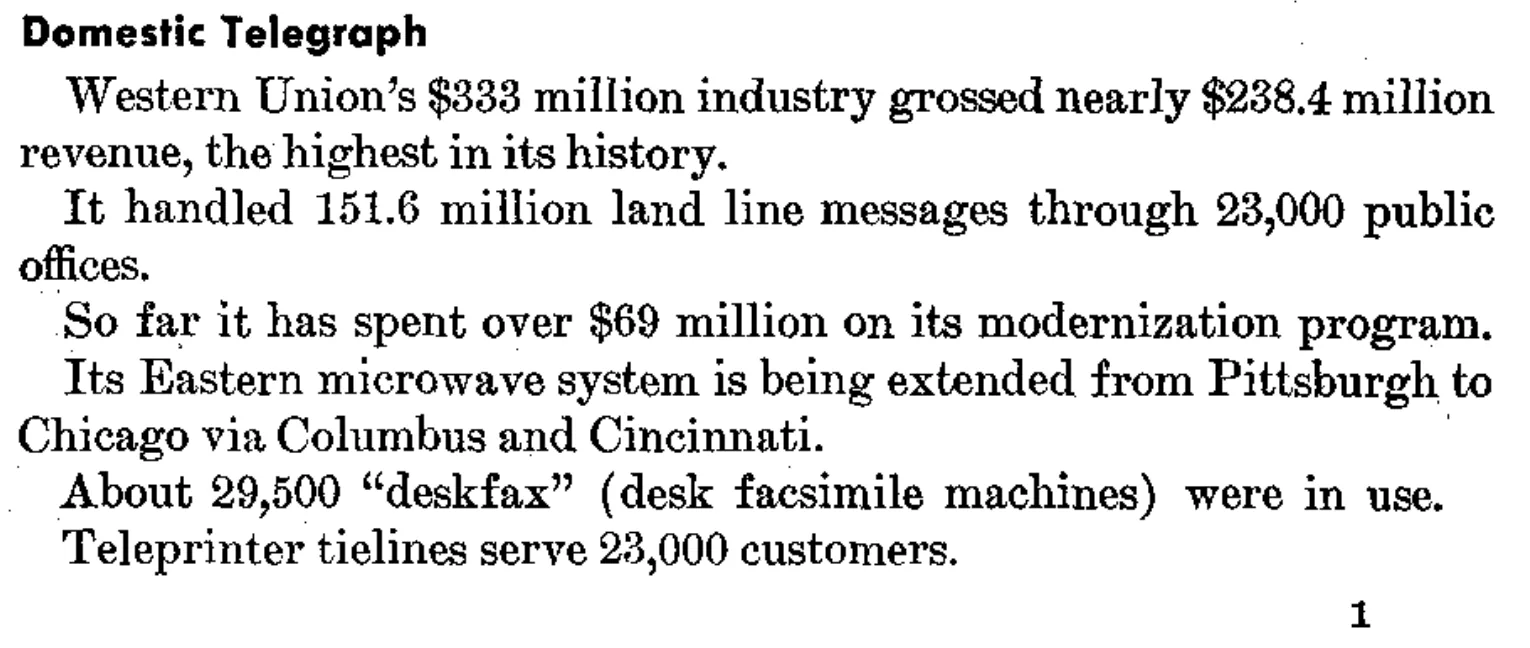
Western Union was a telegraph monopoly running out of reasons to exist. Competitors’ long-distance rates were falling while Western Union’s kept rising. The uniformed messenger, once an iconic mascot, was being phased out as machines took over. They needed a growth story, and they needed it fast. They settled on Telex, a direct-dial teleprinter service still years from commercial launch and already eating a significant share of the R&D budget. It had to work, or Western Union was in trouble.
Market cap of $118M, earnings of $19M, pension outlays of $10M, reserves of $2.4M. The retirement obligations were growing 15% annually, on track to become a $200-250M liability1 with no funding plan behind it. Western Union ran it pay-as-you-go, so the earnings looked real and weren’t. $17 a share for a stock worth pennies.
Munger saw this as a prime short candidate. The company was overstaffed, surrendering pricing power, and watching its technology become obsolete. He’d learned from a previous investment that setups like this didn’t end well. This was his chance to sit on the other side of the table.
 Source: FCC, Statistics of Communications Common Carriers, 1956 (full report)
So Munger shorted the stock, wrote up the thesis, and sent it out.
—
From 1956 to 1958, the stock chopped. From 17 to 22 and back down to 19. Then a recession pulled the shares back to 14. It only went up from there. In 1958, Telex launched, and nobody cared that the pension cost was still compounding underneath it. It ran from 14 to 34¾ in 1958. In 1959 it ranged from 29¾ to 53¾. 1960 was the top. The stock hit 57, over 3x the original 1956 short.
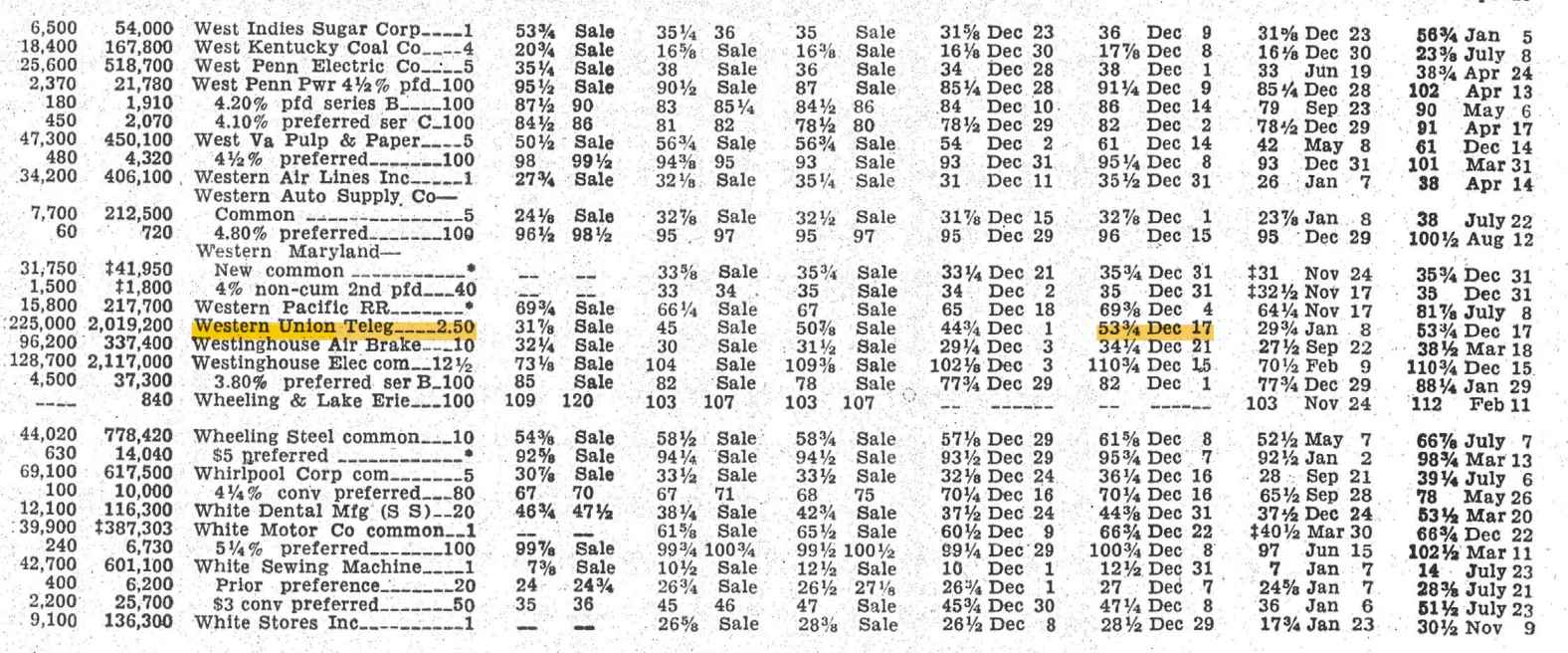 Source: Bank and Quotation Record, NYSE tables, Jan. 1960 issue (full-year 1959) (archive.org)
The whole time, the pension cash cost grew from $10M to $19M, and the debt load more than tripled from $43M to $149M. The Telex growth narrative drowned out the deteriorating fundamentals.
Munger covered somewhere in that run-up2. He’d circulated his report more widely as the shares climbed against him. The market went up, he told more people, the market went up again. “I couldn’t understand it” was about all he had to say. He closed the position at a loss, roughly triple where he’d shorted it, and never shorted a stock again.
—
”Everything we’ve ever thought about shorting worked out eventually. But it’s very painful.” — Warren Buffett
Munger was out of Western Union. Western Union spent the next twenty-eight years proving the math from 1956 correct, and none of it counted because he wasn’t holding the position anymore. Being right early is indistinguishable from being wrong.
In 1962, the pension expense alone was $19M against operating income of $7M, and Western Union still borrowed to pay a $10.5M dividend anyway, because a monopoly in decline can keep writing checks long after it’s stopped earning the right to. They were functionally insolvent, making just enough cash to keep the stock from cratering.
In the 1960s, data networks saved the company again. They raised preferred stock and issued debt to buy the first U.S. domestic communications satellite fleet. Revenue peaked at $335M, but the earnings were deeply negative. Telex was declining 20% a year as MCI and fax machines ate into its market share. Something had to break.
The core business bled $117M in losses across 1983 and 1984. The dividend was suspended. Banks pulled their credit. It took twenty-eight years, but the thesis Munger published in 1956 was finally paying off.
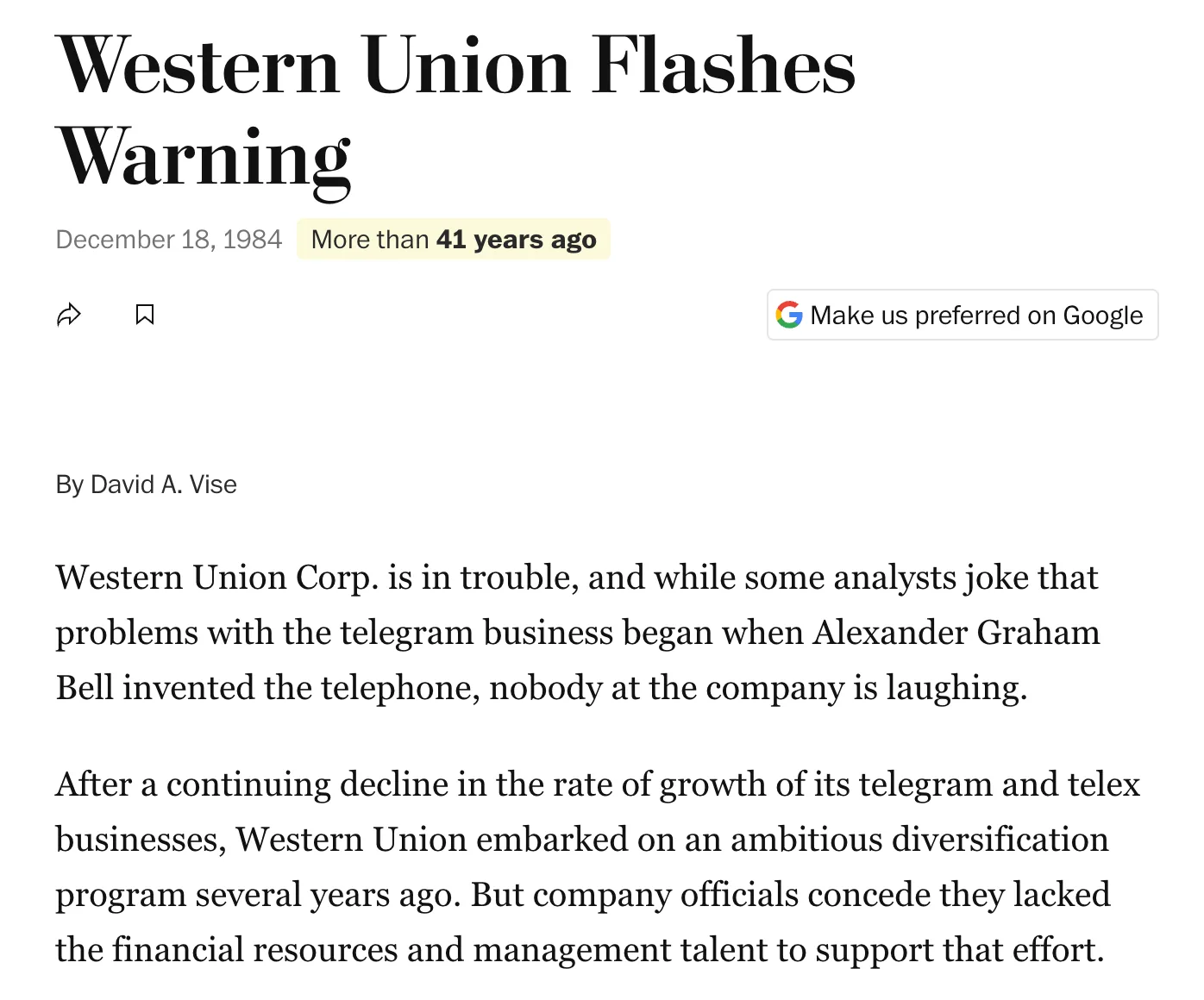 Source: Western Union Flashes Warning, Washington Post, Dec. 19, 1984
In 1987, Drexel arranged the financing that finished it. They tried to salvage the company with strategic divestments and an ill-fated merger with ITT World Communications. They couldn’t escape the inevitable: a November 15, 1991 involuntary Chapter 11. The certificate that once symbolized a monopoly was now worth less than the nail holding Buffett’s up.
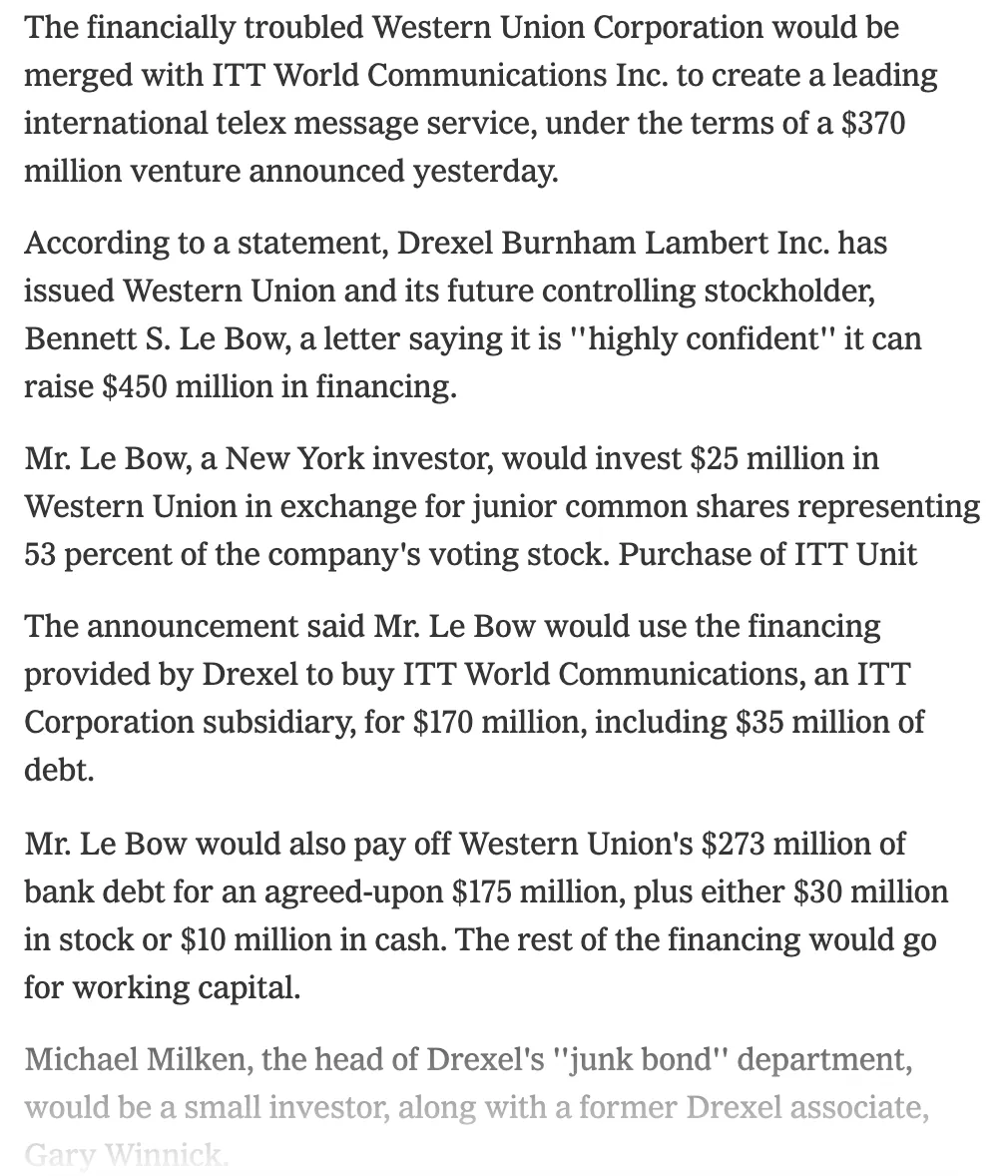 Source: New York Times, May 8, 1987
The money-transfer business came out of the estate intact3. It passed through First Financial, then First Data, which spun it off under the old Western Union name in 2006. A year later, Berkshire bought in. They got out of it quickly.
—
Thank you to Abi, and @dunbelievable for contributions and draft-reading
Footnotes
-
The pension costs were growing 15% a year. A projected-benefit-obligation calculation would suggest a $250M liability. Munger didn’t have that formula in the 1950s, but even a conservative estimate would put a $200M+ liability on the balance sheet. ↩
-
I couldn’t find the exact date Munger covered. The record only shows the position, the report, and the retreat. Judging by the price action, he likely capitulated sometime in 1959 or 1960, into the run that took the stock to its 1960 high. ↩
-
Western Union auctioned off the money-transfer business to pay back the creditors and fund the pension. ↩